
At first, scaling a GCC feels like a win.
Hiring numbers are climbing, new teams are being formed, office space is expanding, and leadership is excited because the center is growing faster than expected. On paper, it looks like momentum.
But somewhere along the way, usually after the initial excitement settles, things start becoming… heavier.
Meetings multiply. Decisions slow down. Teams that once moved quickly now depend on layers of approvals. Managers spend more time coordinating than building. Suddenly, growth starts creating friction instead of acceleration.
And that’s where most companies realize something important: scaling a GCC isn’t just about adding more people. It’s about managing the second-order problems that growth quietly brings with it.
The First Problems Are Easy to Spot. The Real Ones Aren’t.
Most companies prepare for obvious scaling challenges:
- hiring fast enough
- setting up infrastructure
- onboarding new employees
- managing costs
Those are expected.
The harder problems appear later, often when the GCC already looks “successful” from the outside.
These are the second-order effects:
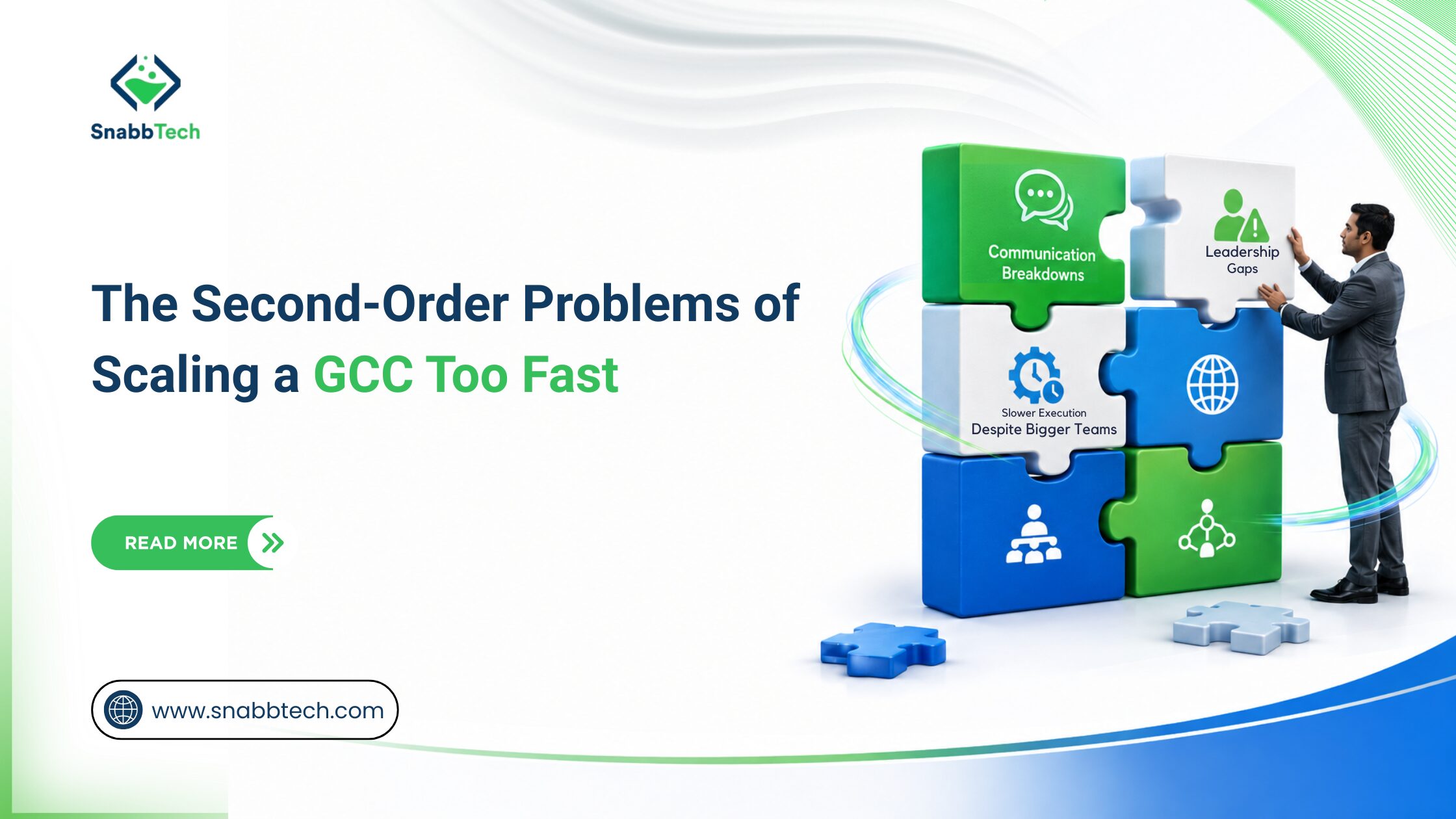
- communication breakdowns
- unclear ownership
- operational overload
- slower execution despite bigger teams
- leadership gaps
- fragmented culture
And the tricky part? None of these happen overnight.
They build slowly in the background.
When Bigger Teams Start Moving Slower
One of the biggest surprises for growing GCCs is realizing that adding more people doesn’t always increase speed.
In fact, beyond a certain point, the opposite often happens.
A product decision that once took one discussion now involves multiple stakeholders, approvals, alignment calls, and follow-ups. Teams become dependent on each other in ways they weren’t before.
The organization gets busier, but not necessarily more effective.
You’ll hear things like:
- “We’re waiting for alignment.”
- “That’s with another team.”
- “Let’s discuss this next week.”
And before anyone notices, execution velocity drops.
Myth: Scaling a GCC is mainly a hiring challenge
The reality is that hiring is the easy part. Coordination at scale is where complexity begins.
Leadership Doesn’t Scale Automatically
Another issue companies underestimate is leadership maturity.
Fast-growing GCCs often focus heavily on recruiting engineers, analysts, and delivery teams. But leadership development usually struggles to keep up with the pace of expansion.
The result is common:
- great individual contributors
- overwhelmed managers
- unclear accountability
- inconsistent decision-making
At smaller scale, energy and hustle can compensate for weak structures. But once teams become larger, leadership quality starts affecting everything — delivery timelines, culture, retention, and even innovation.
This is why some GCCs grow quickly but still feel operationally unstable internally.
Culture Starts Splitting Into Smaller Islands
Culture fragmentation is another second-order problem that rarely gets discussed openly.
When a GCC scales rapidly, new people join faster than the organization can absorb them into a shared way of working. Different teams begin developing their own communication styles, priorities, and expectations.
OOne team works quickly and independently. Another becomes very process-oriented. Before making judgements, a third continuously awaits approval from headquarters.
Eventually, collaboration becomes harder because everyone is working differently.
The organization may still look aligned externally, but internally, small silos begin forming everywhere.
Fact:
Some high-performing GCCs spend more effort building operational alignment than building reporting structures.
The Hidden Dependency on Headquarters
This is one of the most overlooked problems in scaling.
Even after the India center expands considerably, the majority of strategic decisions in many GCCs are still made by headquarters. This appears feasible at first look. But depending too much on it will unavoidably lead to bottlenecks.
Teams stop taking responsibility locally since significant choices are always decided at a higher level.
Instead of making a decision, managers escalate. .
Execution slows because autonomy never evolved alongside growth.
The GCC becomes bigger, but not truly empowered.
The most mature centers eventually shift from:
“Wait for instructions”
to
“Own outcomes independently.”
That transition makes a huge difference.
Speed Can Create Technical Chaos Too
Fast scaling doesn’t just affect people and operations. It affects systems.
When growth happens aggressively, teams naturally prioritize quick delivery. Temporary workflows become permanent processes. Internal tools get patched together. Documentation falls behind.
Over time, operational shortcuts create technical debt.
And the irony is hard to ignore:
the faster companies move early on, the more complexity they sometimes create later.
This is why mature GCCs eventually focus on operational architecture just as much as hiring.
Growth Without Clarity Becomes Expensive
A lot of companies assume GCC success comes from scale alone.
But scale without clarity creates hidden costs:
- slower decision-making
- duplicated work
- communication fatigue
- lower accountability
- higher attrition
- reduced execution quality
None of these problems show up in hiring dashboards initially. But they directly affect long-term performance.
That’s why the best GCCs don’t just scale teams. They scale systems, ownership models, and operational clarity alongside growth.
Final Thoughts
India continues to be one of the strongest destinations for GCC expansion, especially for organizations building product, engineering, AI, analytics, and digital transformation capabilities.
But the GCCs that succeed long-term are usually the ones that recognize second-order problems early before operational complexity becomes deeply embedded.
Because eventually, growth stops being about how many people you hire.
It becomes about how effectively the organization can still think, decide, collaborate, and execute as it grows.
That shift is exactly why companies today are paying more attention to scalable workflows, connected systems, and operational visibility areas where platforms and execution-focused partners like SnabbTech naturally become part of the larger transformation conversation.